
CMS has released the Calendar Year (CY) 2027 Medicare Physician Fee Schedule Final Rule, with significant updates to the Quality Payment Program (QPP) and the Medicare Shared Savings Program. The rule is scheduled for publication in the Federal Register on Nov. 9, 2026, and takes effect Jan. 1, 2027.
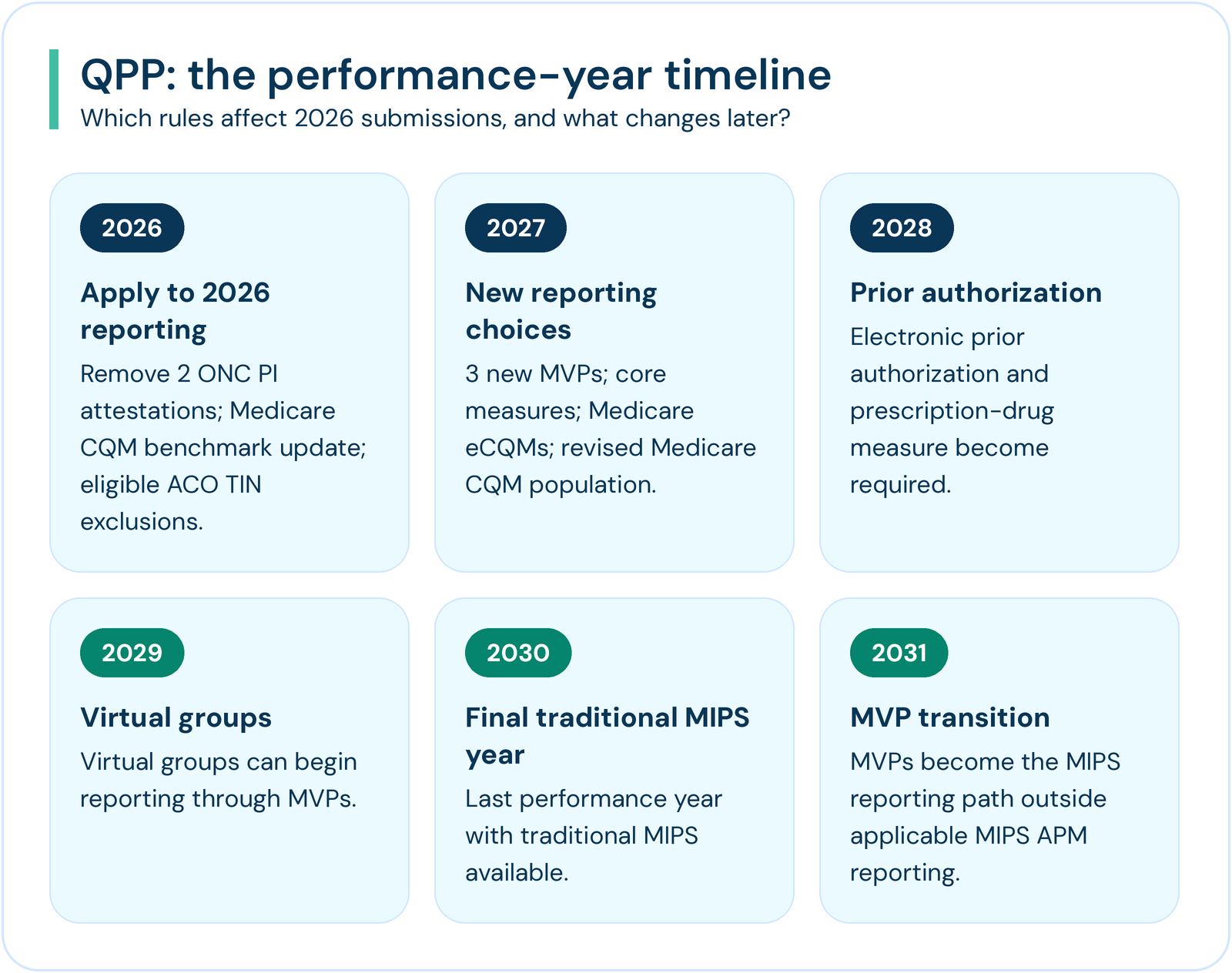
Most provisions begin with the 2027 performance year, but several apply to 2026 reporting, which organizations are about to submit. The rule also sets a clear direction: MIPS Value Pathways (MVPs) as the future of MIPS, more targeted quality measurement, less administrative burden, and more digital reporting options for ACOs.
Changes that affect 2026 reporting
Two Promoting Interoperability attestations are removed
CMS removed two Promoting Interoperability (PI) attestations beginning with the 2026 performance year:
- ONC Direct Review attestation, previously required
- ONC-Authorized Certification Body (ONC-ACB) Surveillance attestation, previously optional
The change applies to traditional MIPS, MVPs, and the APM Performance Pathway (APP). CMS has said 2026 submission files must exclude both attestations. A file that includes either will trigger an alert in the QPP system and must be resubmitted without them. CMS is also removing both attestations as options for manual entry.
What this means: Check that your 2026 PI submission process drops both attestations, even if you collected the data earlier in the year.
Flat benchmarks for Medicare CQMs, including retroactively for 2026
All measures reported through the Medicare CQM collection type will be scored using flat benchmarks for 2027 and later. Previously, flat benchmarks applied only during a Medicare CQM's first two performance periods.
CMS is also applying flat benchmarks retroactively to the 2026 performance year for three measures reported as Medicare CQMs:
- Quality ID 001: Diabetes: Glycemic Status Assessment Greater Than 9%
- Quality ID 134: Preventive Care and Screening: Screening for Depression and Follow-up Plan
- Quality ID 236: Controlling High Blood Pressure
Using 2024 data, CMS estimated that flat benchmarks for these three measures would have raised average quality scores by 11 percentage points for ACOs that reported all three as Medicare CQMs. Results for any individual ACO will depend on its own performance.
What this means: ACOs reporting Medicare CQMs should update their 2026 quality score projections. The change applies only to the Medicare CQM collection type, not to MIPS CQMs or eCQMs.
ACOs may exclude certain participant TINs
Beginning with 2026, Shared Savings Program ACOs may exclude certain participant TINs from quality reporting for individual measures in specified circumstances. Examples include an unexpected practice closure, circumstances outside the ACO's control that prevent access to data, and a specialty EHR that doesn't support the APP Plus measures.
Two safeguards apply:
- After exclusions, the remaining TINs must represent at least 95% of the ACO's assigned beneficiaries for each measure, before the measure specifications are applied.
- The ACO must still meet the 75% data completeness requirement.
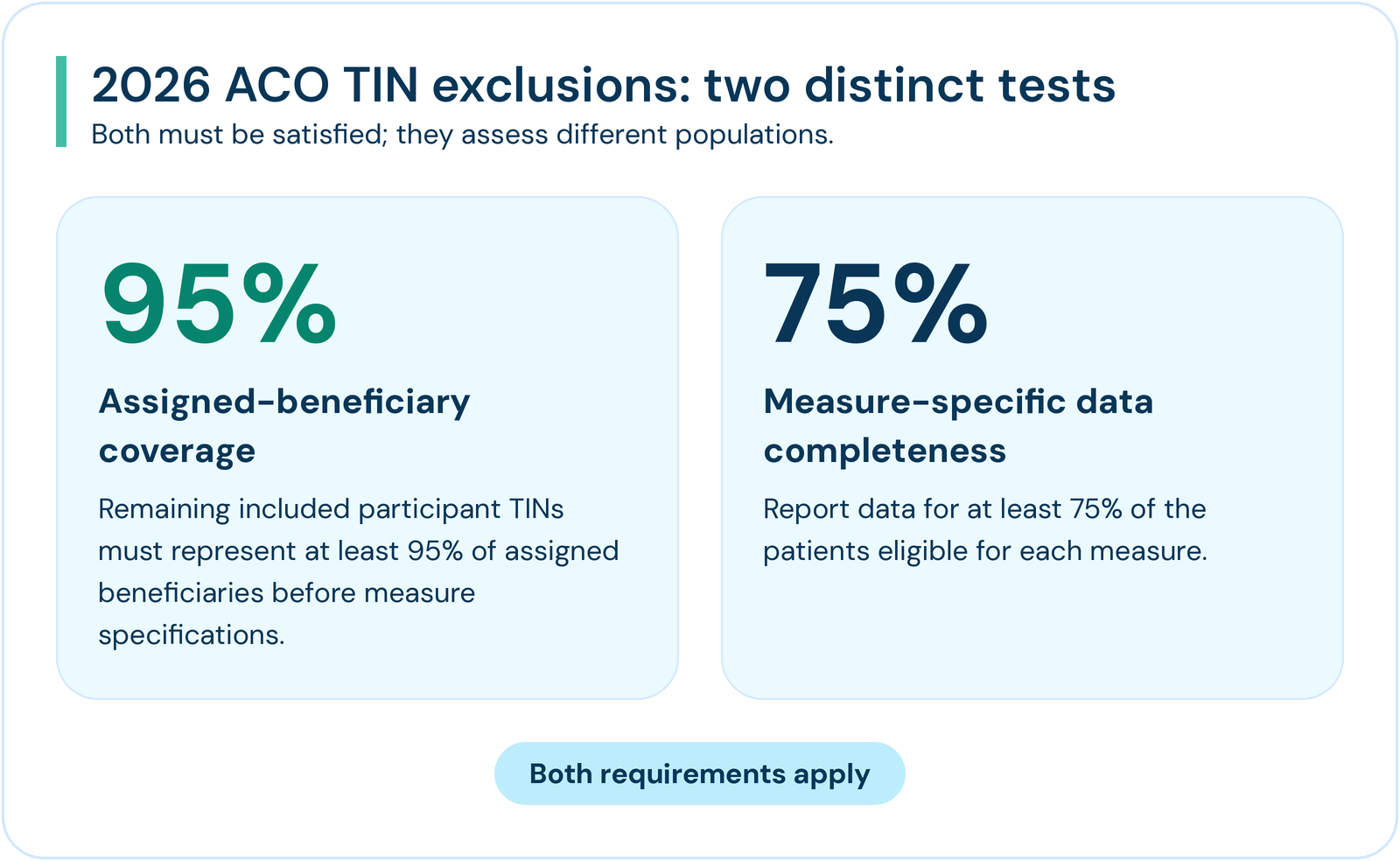
Exclusions can't be used to remove a practice because its patients or performance would lower the ACO's results. To help ACOs check the 95% threshold, CMS will provide a new aggregate report in the third and fourth quarters of each performance year, starting with 2026, through the ACO Management System.
What this means: ACOs with practices on specialty EHRs or whose data they can't fully access should review whether an exclusion applies. They should document the basis before using it.
MIPS changes beginning in 2027
Traditional MIPS continues through 2030
CMS had proposed ending traditional MIPS after 2028. After public comment, it extended the timeline: traditional MIPS remains available through the 2030 performance year. Beginning in 2031, clinicians who aren't in a MIPS Alternative Payment Model must report through an MVP. Clinicians in a MIPS APM can continue to report the APP. Virtual groups will be able to report MVPs beginning in 2029.
What this means: There's no need to leave traditional MIPS in 2027, but the extra two years are time to plan the move to MVPs, including measure fit, specialty alignment, and subgroup structure.
Three new MVPs bring the total to 30
Three new MVPs are available for 2027: Diabetic Disease, Hospitalist and Hypertension. CMS is also modifying all 27 existing MVPs, adding MIPS core measures, expanding measure choices, and removing measures leaving the inventory. The Rehabilitative Support for Musculoskeletal Care MVP is renamed Rehabilitative Support.
What this means: Review MVP selections for 2027 rather than assuming 2026 configurations still apply.
MIPS core measures replace the outcome or high-priority requirement
Beginning in 2027, the requirement to report at least one outcome measure, or a high-priority measure if no outcome measure applies, is replaced by a MIPS core measure requirement. CMS has designated 78 measures as core measures.
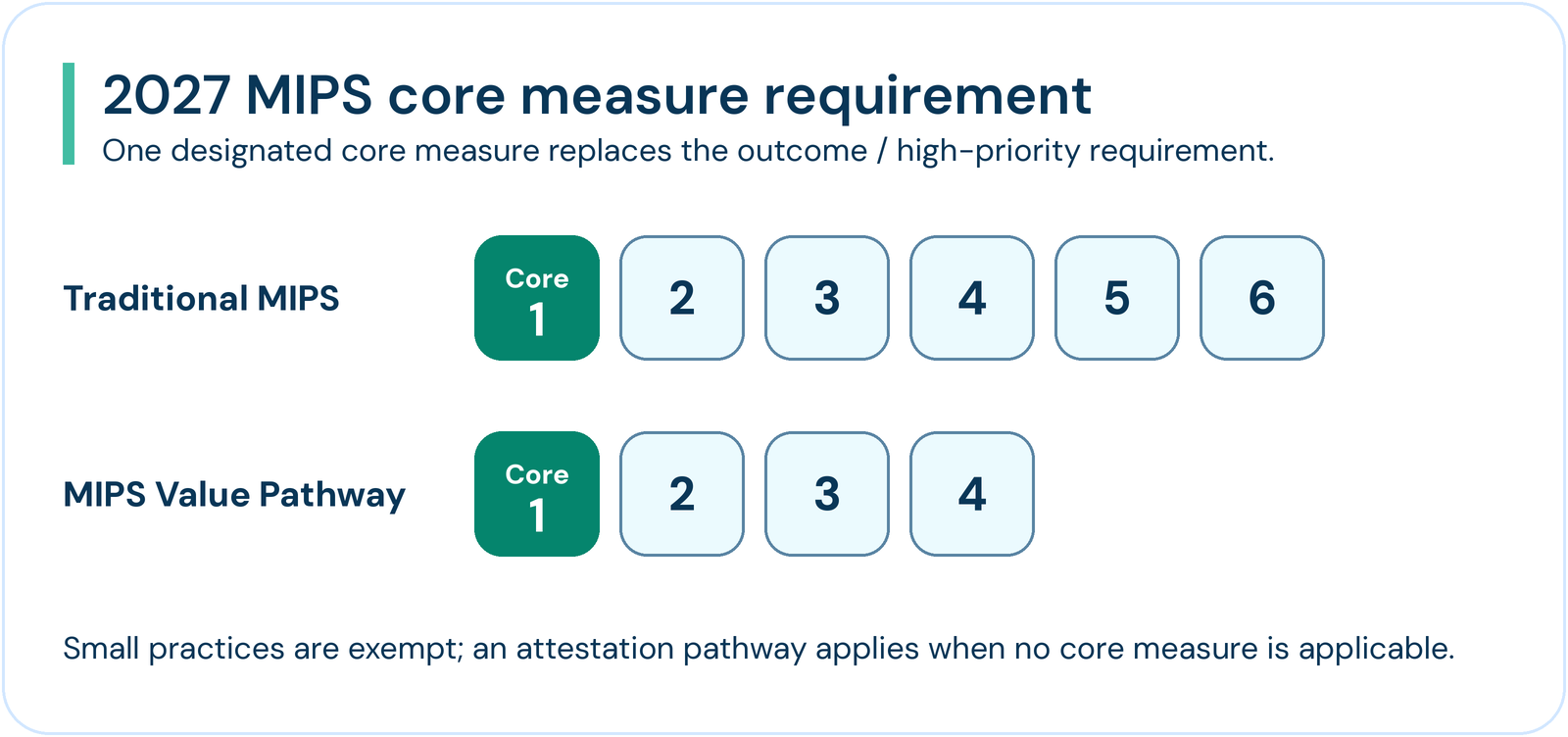
- Traditional MIPS: At least one of the six required quality measures must be a core measure.
- MVPs: At least one of the four required quality measures must be a core measure in the selected MVP.
If no core measure is available or applicable, clinicians can attest to that and report another measure instead. Without a core measure or a valid attestation, one quality measure receives zero achievement points. Small practices are exempt from both the requirement and the attestation.
What this means: Confirm core measure availability early, rather than discovering a gap at submission.
The quality measure inventory changes
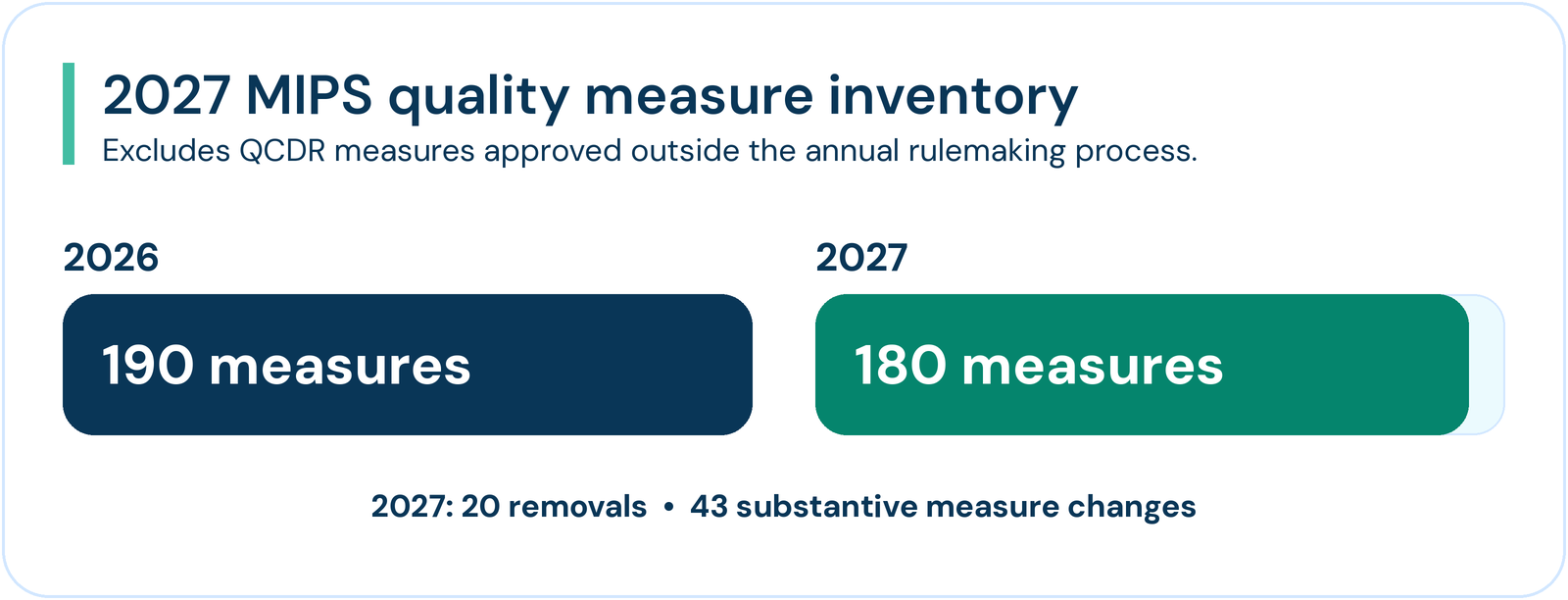
The 2027 inventory has 180 MIPS quality measures, down from 190 in 2026. The 180 doesn't include QCDR measures.
Changes include:
- Removal of 20 measures
- Substantive changes to 43 existing measures
- Two new measures focused on prevention and chronic disease management, one delayed until 2028
- Four current QCDR measures adopted as MIPS CQMs
- Seven functional improvement measures replaced by five functional outcome measures for orthopedic patients
Fifteen measures will also receive CMS' previously defined topped-out measure benchmarks, which support clinicians whose measure choices are limited.
What this means: A 2027 measure review needs to cover updated specifications, benchmarks and collection types, not just whether a measure still exists.
ACO reporting changes beginning in 2027
Medicare eCQMs become a new collection type
Beginning in 2027, ACOs can report Medicare eCQMs: eCQM specifications applied only to the ACO's assigned beneficiaries, rather than to all patients and payers. CMS will provide each ACO with a list of beneficiaries eligible for Medicare eCQMs. Medicare eCQMs are scored using flat benchmarks, but ACOs that choose them aren't eligible for the Complex Organization Adjustment or the eCQM/MIPS CQM reporting incentive.
What this means: Medicare eCQMs add an option for ACOs that report from EHRs but struggle to aggregate all-payer data. The trade-off in incentives needs to be weighed against the data advantages.
Medicare CQM eligibility aligns with ACO assignment
Beginning in 2027, the population eligible for Medicare CQMs is redefined to match the ACO's assigned beneficiaries, a narrower population than before.
What this means: Expect denominators, data aggregation, and patient matching to change. Be careful comparing 2027 results with earlier years, since a change in who's measured can move rates.
MIPS CQMs remain available for ACOs
MIPS CQMs remain available to Shared Savings Program ACOs in 2027 and later, along with the MIPS CQM reporting incentive.
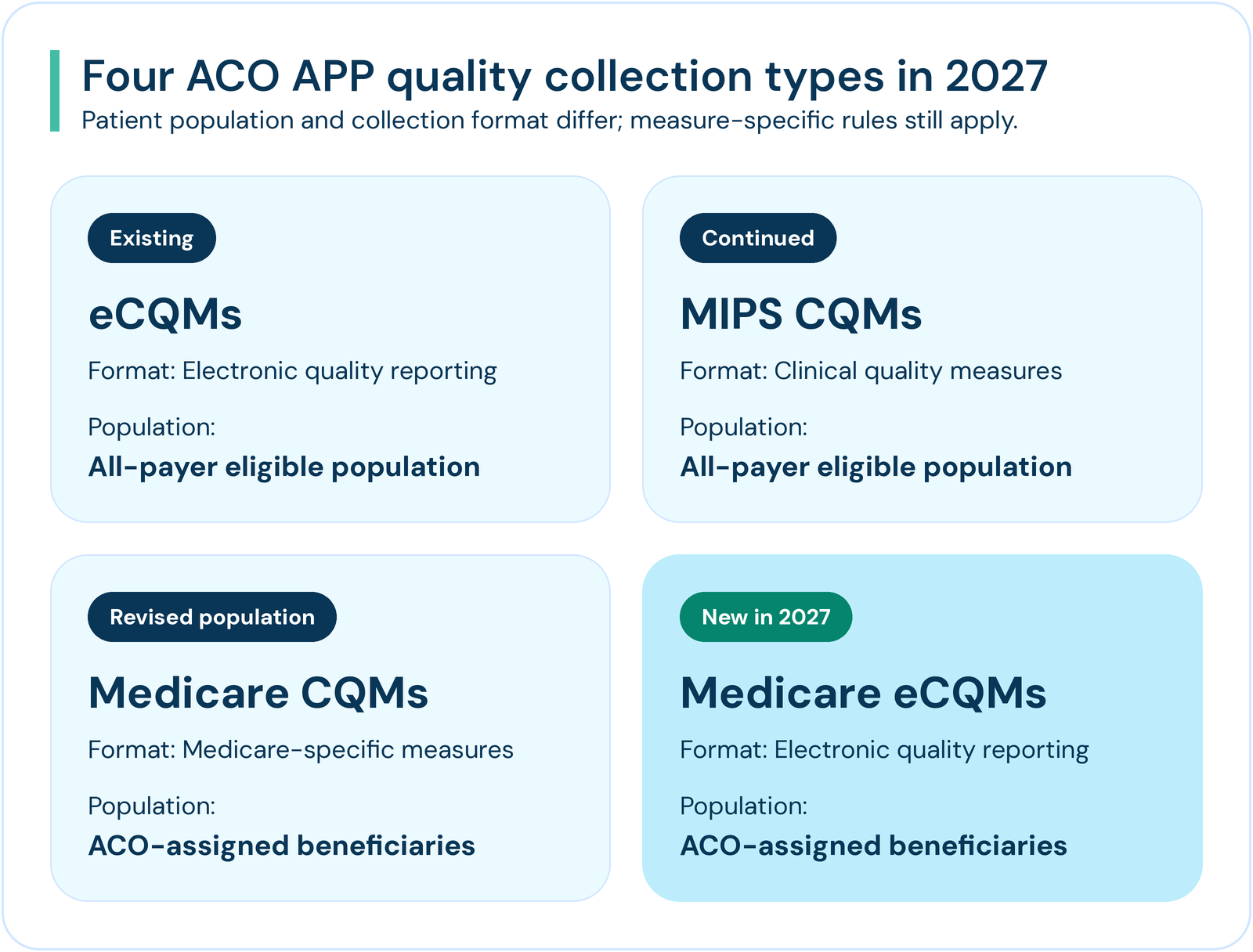
What this means: ACOs now have four collection types to choose from:
1. eCQMs
2. MIPS CQMs
3. Medicare CQMs
4. Medicare eCQMs
The best choice depends on data availability, benchmarks, and incentives. Those may differ by measure.
The APP Plus measure set stays at eight measures
CMS removed two measures that had been scheduled to join APP Plus: Initiation and Engagement of Substance Use Disorder Treatment (Quality ID 305) and Adult Immunization Status (Quality ID 493). The set remains at eight measures for 2027.
CMS also finalized substantive changes to several APP Plus measures, including Quality ID 001 (eCQM collection type only), 134, and 479.
What this means: Review final 2027 specifications and collection types before configuring 2027 reporting.
New ways to meet the ACO CEHRT requirement
Beginning in 2027, ACOs demonstrate use of certified EHR technology at the ACO level, in one of several ways finalized in the rule. One option is to completely report at least one APP Plus measure as an eCQM or Medicare eCQM, using technology certified to ONC's clinical quality measure criteria, while meeting data completeness. The other options include attesting to ACO-level CEHRT use metrics. There is no small-practice exemption.
What this means: The CEHRT requirement is now linked to collection type choices. An ACO that plans to report every measure as a MIPS CQM or Medicare CQM needs to confirm which other option it will use.
Shared Savings Program financial and beneficiary changes
The rule also finalizes changes to ACO benchmarks, sharing rates, and beneficiary tools. These affect how much of their savings ACOs keep, which makes meeting the quality standard all the more valuable.
- BASIC Level E sharing rate rises from 50% to 60% for agreement periods beginning on or after Jan. 1, 2027.
- The positive regional adjustment is reduced for ENHANCED ACOs, with its maximum weight lowered from 50% to 35%.
- The prior savings adjustment increases, with its scaling factor raised from 50% to 75%, returning more of an ACO's prior savings to its rebased benchmark.
- A new growth adjustment rewards ACOs for bringing in clinicians and beneficiaries new to value-based care.
- A guardrail on the ACPT keeps CMS' projected growth rate from running more than 1 percentage point below, or more than 1.5 points above, actual growth. For agreement periods that began in 2024 through 2026, the lower guardrail applies retroactively.
- Part B cost-sharing support: Eligible ACOs may reduce or waive Part B deductibles and coinsurance for selected services and beneficiaries. CMS will take applications in early 2027, with a target start of April 1, 2027.
- G2211 becomes a modifier: modifier B1 pays 16% of the base E/M visit, and modifier B2 pays 32% for clinicians participating in an ACO.
- Prepaid shared savings ends, with ACO eligibility ending Jan. 1, 2027.
What this means: ACOs choosing between BASIC and ENHANCED for 2027 should rerun their financial models under the final rules. ACOs in agreement periods that started in 2024 through 2026 should expect the ACPT guardrail to affect PY 2025 results.
Promoting Interoperability in 2027 and beyond
Beginning in 2027
- The Security Risk Analysis measure is removed from the MIPS PI measure set. This doesn't remove HIPAA's separate security risk analysis requirement.
- Electronic Prior Authorization becomes an optional measure worth 10 bonus points.
Beginning in 2028
- Electronic Prior Authorization for medical items and services becomes required.
- A new Electronic Prior Authorization for Prescription Drugs measure becomes required.
CMS is also updating the definition of certified EHR technology to align with ONC's certification changes.
Other changes worth knowing
- Performance threshold: It stays at 75 points through the 2028 performance year.
- Improvement activities: There are six new activities, five modified, and 11 removed for 2027.
- Advanced APMs: Qualifying APM Participant (QP) and Partial QP determinations move from the NPI level to the TIN/NPI level, so incentives go only to TINs participating in Advanced APMs. CMS is also updating 2026 QP and Partial QP thresholds under the Consolidated Appropriations Act, 2026.
- Ambulatory Specialty Model: The rule finalizes refinements to the mandatory model, which begins Jan. 1, 2027, for selected cardiologists and low back pain specialists.
Preparing for two performance years at once
During 2027, organizations will be finishing 2026 submissions while setting up 2027 reporting, so reporting systems need to support two sets of rules at the same time. An organization may need to:
- Submit 2026 PI data without the two removed attestations
- Apply flat benchmarks to 2026 Medicare CQM scores
- Decide whether TIN exclusions apply to its 2026 ACO reporting
- Configure 2027 MVPs and the MIPS core measure requirement
- Apply 2027 measure specifications without affecting 2026 calculations
- Evaluate Medicare eCQMs and the new Medicare CQM population
That is more than an annual measure update. It requires managing each performance year's rules, populations, benchmarks, and submission formats separately. For organizations combining data from several EHRs, accurate patient matching and data aggregation remain essential.
Looking ahead
The Final Rule reinforces four trends:
1. Specialty-specific reporting is becoming central, with new MVPs and the eventual end of traditional MIPS.
2. Measure selection matters more, with the new core measure requirement and a changing inventory.
3. ACOs have more options — and harder choices — across collection types, populations, benchmarks, and TIN exclusions.
4. Data infrastructure remains the foundation for collecting and validating clinical data and supporting more than one performance year at once.
How Healthmonix helps
Healthmonix has supported clinicians, medical groups and ACOs with CMS quality reporting since 2009, across MIPS, MVPs and the Medicare Shared Savings Program. Healthmonix Prism™ brings quality reporting and performance analytics together on a common data foundation, so organizations can manage changing program requirements while keeping visibility into clinical performance.
Contact Healthmonix to discuss how the 2027 Final Rule affects your MIPS, MVP, or ACO reporting strategy.
Sources
- CMS, CY 2027 Medicare Physician Fee Schedule Final Rule (CMS-1848-F), scheduled for Federal Register publication Nov. 9, 2026: https://www.federalregister.gov/d/2026-22743
- CMS, CY 2027 Quality Payment Program Final Rule Fact Sheet and Policy Comparison Table, November 2026
- CMS, Quality Payment Program: https://qpp.cms.gov/
This article summarizes selected quality reporting provisions of the CY 2027 Final Rule. Organizations should consult CMS regulations, measure specifications and official reporting guidance for their circumstances.