
For roughly a decade, the operating assumption of value-based care has been that you transform outcomes and costs by transforming primary care:
• Attribute the patient to a PCP
• Hand the PCP a panel and a risk arrangement
• Give the care team a gap list
• Let the rest of the system carry on
That model has produced real wins. It’s also produced a generation of risk-bearing organizations that have squeezed most of what they can out of the levers a primary care physician controls and now find themselves staring at the part of the spend they don’t.
That part is large. Milliman’s analysis of a 5 percent Medicare FFS sample, presented at the APG Spring Meeting in San Diego, found that specialists manage or are involved in roughly 80% of total cost of care. Optum’s Ken Cohen put the number closer to 85%.
Whichever figure you prefer, the conclusion is the same: any VBC strategy that doesn’t engage specialists leaves most of the savings opportunity on the table. The next phase of value-based care will be won or lost in specialty.
If roughly 80% of the spend sits with specialists, an organization that hasn't engaged them analytically isn't running a complete value-based care strategy. It's running half of one.
CMS has drawn a line: Specialty cost is no longer optional
If there were any doubt about where CMS is headed, the current and emerging model portfolio has removed it. CMMI started more than a decade ago with voluntary episode models such as BPCI. Those became smaller mandatory models such as CJR.
Today, TEAM makes 30-day episodic risk mandatory for roughly 700 hospitals across multiple procedure categories. CJR X expands 90-day joint replacement episodes to most hospitals.
At the same time:
- The Shadow Bundles data sharing program is feeding specialty cost information into MSSP ACOs to build capacity.
- LEAD layers CMS administered risk arrangements that bring specialists directly into accountable care.
- EOM does this for oncology, KCC for nephrology, ACCESS for chronic conditions managed by specialists, and ASM for low back pain and heart failure.
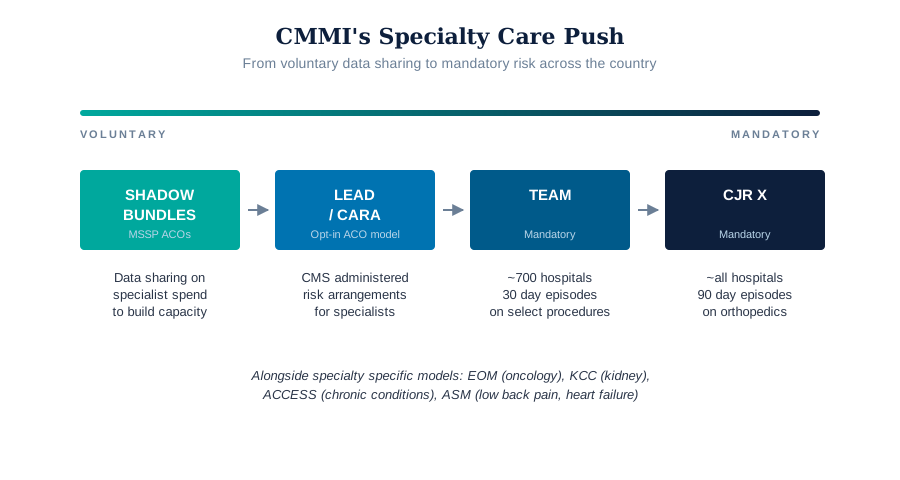 The progression of CMMI’s specialty care push, from voluntary data sharing to mandatory episodic risk.
The message from CMMI is consistent across a half-dozen models: specialty cost is the next frontier. The agency will continue tightening the screws whether the field is ready or not.
The trap most organizations fall into
Most organizations aren’t ready. When an ACO sees that specialty is unmanaged, the natural reflex is to push risk downstream: find an oncology vendor to take cancer risk, an orthopedics vendor to take MSK risk, and so on. This sometimes works.
More often, it produces arrangements where neither side fully understands what has been transferred. The specialist takes risk on levers they can’t control. The relationship sours within 18 months.
Underneath that is a framing problem. As one MA panel at APG put it, providers, whether primary care or specialty, don’t want risk on things they can’t influence.
The old approach of letting providers keep fee for service while taking downside on total cost of care created a generation of groups that lost money on pharmacy spend, out of network utilization, and catastrophic inpatient cases they had no practical ability to move. The same mistake is being repeated one specialty at a time.
A spine surgeon can influence surgical efficiency, site of service, repeat surgery rates, and complication rates. A spine surgeon can’t influence the price of biologics. Risk arrangements that ignore that distinction don’t survive contact with reality.
For external audiences, the implication is straightforward. If your current strategy is finding a vendor who will take the risk, you’re likely over-delegating, misaligning incentives, and setting yourself up for churn rather than durable performance.
A better way to think about specialty risk
A more productive starting point is the analytical framework laid out by Pamela Pelizzari at APG, which organizes the question around two axes:
1. How manageable the variability is in a given specialty’s spending
2. How much risk your organization can tolerate
Cross those axes and you get four clean strategies:
- If variability is random and the dollars are large, avoid. Carve that spend out of total cost of care.
- If variability is random but tolerable, monitor. Watch it, but do not act yet.
- If variability is manageable and tolerable, manage. Keep the risk and work the levers.
- If variability is manageable but the dollars exceed your tolerance, transfer.
Partner with a specialty group that has the volume and capability to absorb it. .svg)
The specialty risk framework. Strategy depends on whether variability is moveable and whether the dollars exceed risk tolerance.
The framework is powerful because it forces you to answer a question most organizations skip: is the variability we are seeing moveable? Oncology and orthopedics often land in very different quadrants. So do cardiology and dermatology.
To apply the framework, you need 3 core analytical capabilities that most ACOs lack today:
- A clinical episode builder that groups spending around clinically meaningful units of care.
- Specialty specific risk adjustment that goes beyond generic HCC scoring.
- Fee schedule analytics that can price future exposure under different payment models.
None of these are exotic, but all are missing from the typical regional ACO’s toolkit. For clients and prospects, this is where partnering with a purpose built analytics and design team begins to matter.
What success looks like when you build the capability
The most compelling evidence that this approach works came from Ken Cohen’s cardiology results. The clinical foundation is a referral algorithm that replaces nuclear stress testing with coronary CT angiography, CCTA, and FFR for stable chest pain without known CAD.
The CONSERVE study established the underlying evidence base. CCTA reduces:
- Invasive coronary angiograms by 78 percent.
- Revascularizations by 45 percent.
- Cardiovascular costs by 50 percent.
At Kelsey Seybold, replacing nuclear stress tests with CCTA over 18 months drove a 67% reduction in unnecessary coronary angiograms.
The clinical change is necessary, but it isn’t enough. The infrastructure around it makes it durable:
- A National Specialist Preferencing program that scores interventional cardiologists on specialty specific performance such as clean cath rate, appropriate CCTA use before catheterization, overuse of stenting, and post PCI complications, together with cost efficiency in roughly a 65 to 35 split.
- An Order Utility that surfaces tiered specialist options at the point of referral with quality, distance, and utilization data, so primary care isn’t referring blind.
- A market level scatter plot that shows leadership which cardiologists cluster in the high quality, high efficiency quadrant and which don’t. In Massachusetts, employed cardiologists visibly cluster in the upper right, while the broader market remains scattered.
The funding model is where this becomes self-reinforcing. Reductions in low-value care fund a value-based incentive pool that pays specialists for hitting performance targets.
In Cohen’s spine surgery example, a surgeon performing 200 surgeries a year, with achievable reductions in HOPD utilization, epidural steroid injections, lumbar fusion rates, 2-year repeat surgery rates, and complications, generates a $1.72 million annual contribution to the pool. The surgeon isn’t asked to take risk on the price of hardware or the cost of catastrophic inpatient cases. They’re paid to do what they control and do it better.
.svg) A spine surgery value based incentive pool. The surgeon is paid for moving levers they actually control.
A spine surgery value based incentive pool. The surgeon is paid for moving levers they actually control.
For client organizations, the lesson is clear: when you pair evidence-based clinical change with transparent performance data and a well-designed funding mechanism, specialists will engage and the economics will support it.
Where most organizations are stuck, and why that is fixable
The organizations succeeding in specialty risk aren’t fundamentally different in mission or talent from those that are struggling. What they have is a well-defined set of capabilities:
- The ability to group claims into clinical episodes that clinicians recognize.
- The ability to risk adjust fairly at the specialty level.
- The ability to benchmark against externally calibrated datasets.
- The ability to price future risk and structure contracts that target the right levers for each specialty.
- Operational tools such as preferred specialist networks, referral decision support, and transparent feedback loops to clinicians.
Most regional ACOs and health systems don’t have those capabilities in house. They won’t build them fast enough to keep up with CMS timelines. Some will partner. Some will buy. Some will discover, 2-3 contract cycles from now, that they should have done one or the other.
The math isn’t subtle. If roughly 80% of spend sits with specialists and CMS is making specialty risk mandatory across an expanding set of clinical areas, an organization that hasn’t engaged specialists analytically isn’t running a complete value-based care strategy. It’s running half of one.
The window to fix that is closing.
What you can do in the next 12-18 months
For external clients and prospects, the immediate question is what to do now. A pragmatic 12–18-month agenda usually includes:
- Baseline your exposure. Map where your specialty spend lives today and how variable it is by condition, site, and provider, using clinical episode analytics.
- Prioritize 3 to 5 specialties. Apply the avoid, monitor, manage, and transfer framework to identify where to start, based on both variability and your risk tolerance.
- Co design with specialists, not for them. Bring specialists into the design of metrics, preferred pathways, and incentive structures so that every measure reflects something they control.
- Stand up 1-2 flagship use cases. For example, a cardiology referral redesign such as the CCTA example, or a spine surgery program with clearly defined indications, sites of service, and post-operative pathways.
- Build the data plumbing once and reuse it. Invest in core capabilities such as episode grouping, specialty risk adjustment, and fee schedule analytics, so you can rapidly extend to new models such as TEAM, ASM, or EOM as they go live.
This is the work that separates organizations that will thrive in the next wave of CMS models from those that will find themselves reacting one mandatory model at a time.